Welcome to the Nubian History Page
The richness of peoples culture is celebrated no matter where they are from this page is to share the information and contribution of all menalated people who have either been forgotten or deliberatly deleted out of world history.
LET US KNOW IF YOU LIKE THIS PAGE
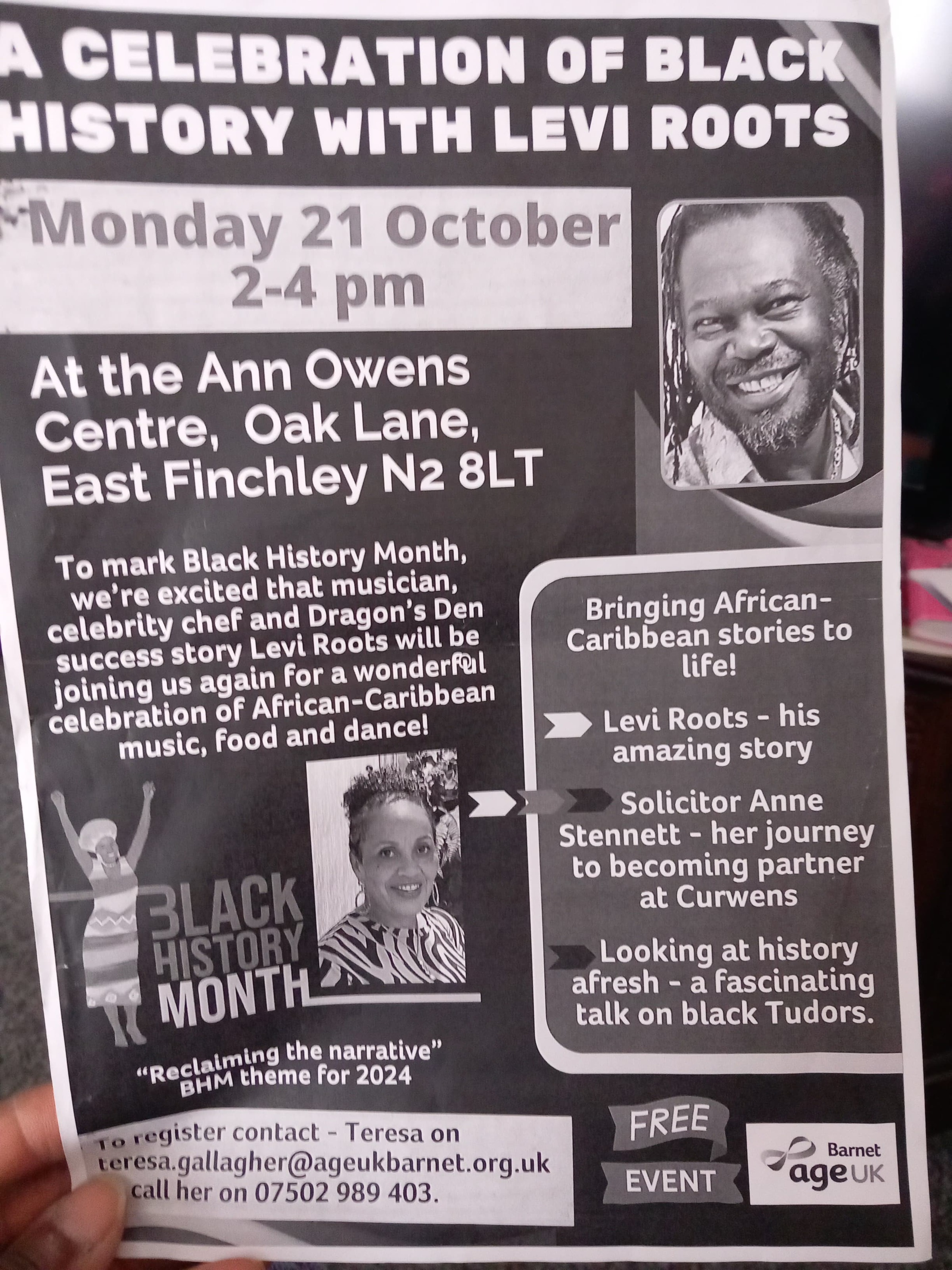
LEVI ROOTS and REMI SOULSTAR and guests
The envioroment was electric and the audience was waiting to listen to the guests and even tho I felt slightly aprehensive I knew this was a honour and to be able to sing a great classic was a blessing.
Everyone liked it as you can see and will definiatly be looking forward to perform at more black history events in futre .
Marcus Mosiah Garvey Jr
Marcus Mosiah Garvey Jr. ONH (17 August 1887 – 10 June 1940) was a Jamaican political activist. He was the founder and first President-General of the Universal Negro Improvement Association and African Communities League (UNIA-ACL, commonly known as UNIA), through which he declared himself Provisional President of Africa. Garvey was ideologically a black nationalist and Pan-Africanist. His ideas came to be known as Garveyism.
Garvey was born into a moderately prosperous Afro-Jamaican family in Saint Ann's Bay and was apprenticed into the print trade as a teenager. Working in Kingston, he got involved in trade unionism before living briefly in Costa Rica, Panama, and England. On returning to Jamaica, he founded the UNIA in 1914. In 1916, he moved to the United States and established a UNIA branch in New York City's Harlem district. Emphasising unity between Africans and the African diaspora, he campaigned for an end to European colonial rule in Africa and advocated the political unification of the continent. He envisioned a unified Africa as a one-party state, governed by himself, that would enact laws to ensure black racial purity. Although he never visited the continent, he was committed to the Back-to-Africa movement, arguing that part of the diaspora should migrate there. Garveyist ideas became increasingly popular and the UNIA grew in membership. His black separatist views—and his relationship with white racists like the Ku Klux Klan (KKK) in the interest of advancing their shared goal of racial separatism—caused a division between Garvey and other prominent African-American civil rights activists such as W. E. B. Du Bois who promoted racial integration.
Believing that black people needed to be financially independent from white-dominated societies, Garvey launched various businesses in the U.S., including the Negro Factories Corporation and Negro World newspaper. In 1919, he became President of the Black Star Line shipping and passenger company, designed to forge a link between North America and Africa and facilitate African-American migration to Liberia. In 1923 Garvey was convicted of mail fraud for selling the company's stock and he was imprisoned in the United States Penitentiary, Atlanta for nearly two years. Many commentators[who?] have argued that the trial was politically motivated; Garvey blamed Jewish people, claiming that they were prejudiced against him because of his links to the KKK. After his sentence was commuted by U.S. president Calvin Coolidge, he was deported to Jamaica in 1927. Settling in Kingston with his wife Amy Jacques, Garvey established the People's Political Party in 1929, briefly serving as a city councillor. With the UNIA in increasing financial difficulty, he relocated to London in 1935, where his anti-socialist stance distanced him from many of the city's black activists. He died there in 1940, and in 1964 his body was returned to Jamaica for reburial in Kingston's National Heroes Park.
Garvey was a controversial figure. Some in the African diasporic community regarded him as a pretentious demagogue and they were highly critical of his collaboration with white supremacists, his violent rhetoric and his prejudice against mixed-race people and Jews. He received praise for encouraging a sense of pride and self-worth among Africans and the African diaspora amid widespread poverty, discrimination and colonialism. In Jamaica he is recognized as a national hero being the first to be recognized as such.[1] His ideas exerted a considerable influence on such movements as Rastafari, the Nation of Islam and the Black Power Movement.
Learn more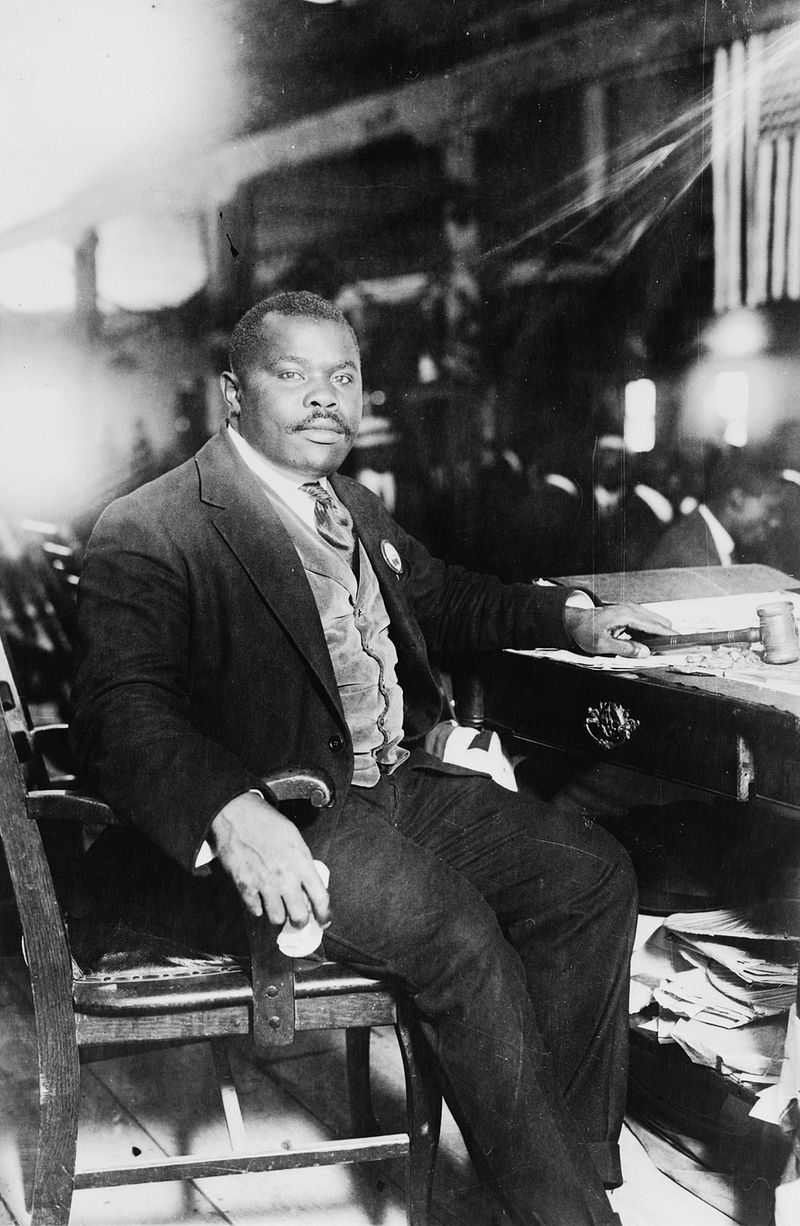
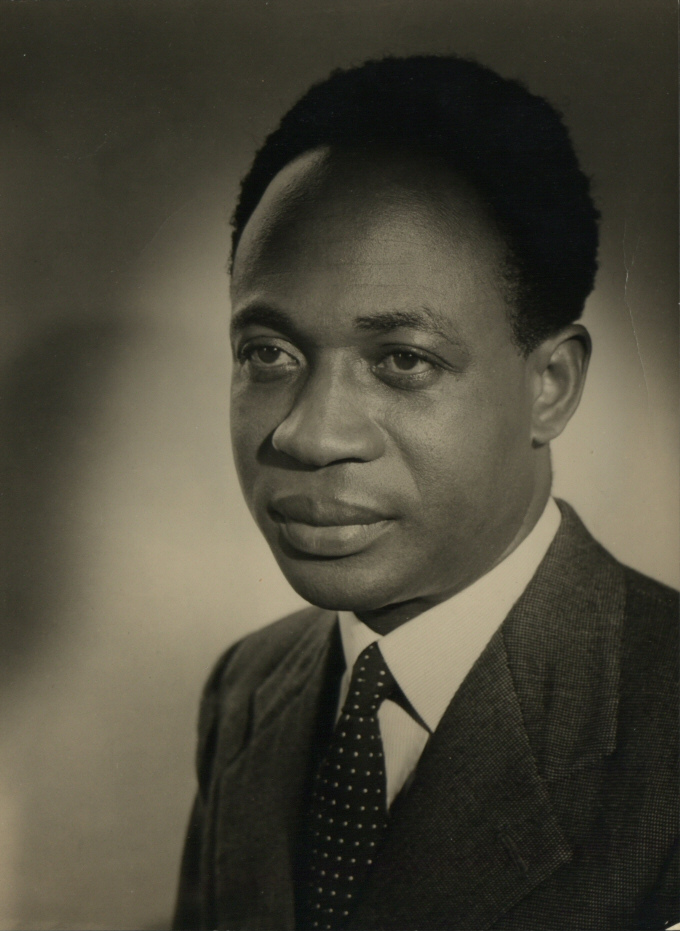
Francis Kwame Nkrumah
Francis Kwame Nkrumah (21 September 1909 – 27 April 1972) was a Ghanaian politician, political theorist, and revolutionary. He served as Prime Minister of the Gold Coast from 1952 until 1957, when it gained independence from Britain.[1] He was then the first Prime Minister and then the President of Ghana, from 1957 until 1966. An influential advocate of Pan-Africanism, Nkrumah was a founding member of the Organization of African Unity (OAU) and winner of the Lenin Peace Prize from the Soviet Union in 1962.[2]
After twelve years abroad pursuing higher education, developing his political philosophy, and organizing with other diasporic pan-Africanists, Nkrumah returned to the Gold Coast to begin his political career as an advocate of national independence.[3] He formed the Convention People's Party, which achieved rapid success through its unprecedented appeal to the common voter.[4] He became Prime Minister in 1952 and retained the position when Ghana declared independence from Britain in 1957. In 1960, Ghanaians approved a new constitution and elected Nkrumah President.[5]
His administration was primarily socialist as well as nationalist. It funded national industrial and energy projects, developed a strong national education system and promoted a pan-Africanist culture.[6] Under Nkrumah, Ghana played a leading role in African international relations during the decolonization period.[7]
After multiple failed attempts on his life, coupled with increasingly difficult local economic conditions, Nkrumah's government became authoritarian in the 1960s, as he repressed political opposition and conducted elections that were not free and fair.[8][9][10][11][12] In 1964, a constitutional amendment made Ghana a one-party state, with Nkrumah as president for life of both the nation and its party.[13] He fostered a personality cult, forming ideological institutes and adopting the title of 'Osagyefo Dr.'[14] Nkrumah was deposed in 1966 in a coup d'état by the National Liberation Council, under whose supervision the country's economy was privatized.[15] Nkrumah lived the rest of his life in Guinea, where he was named honorary co-president.[16][7][17]
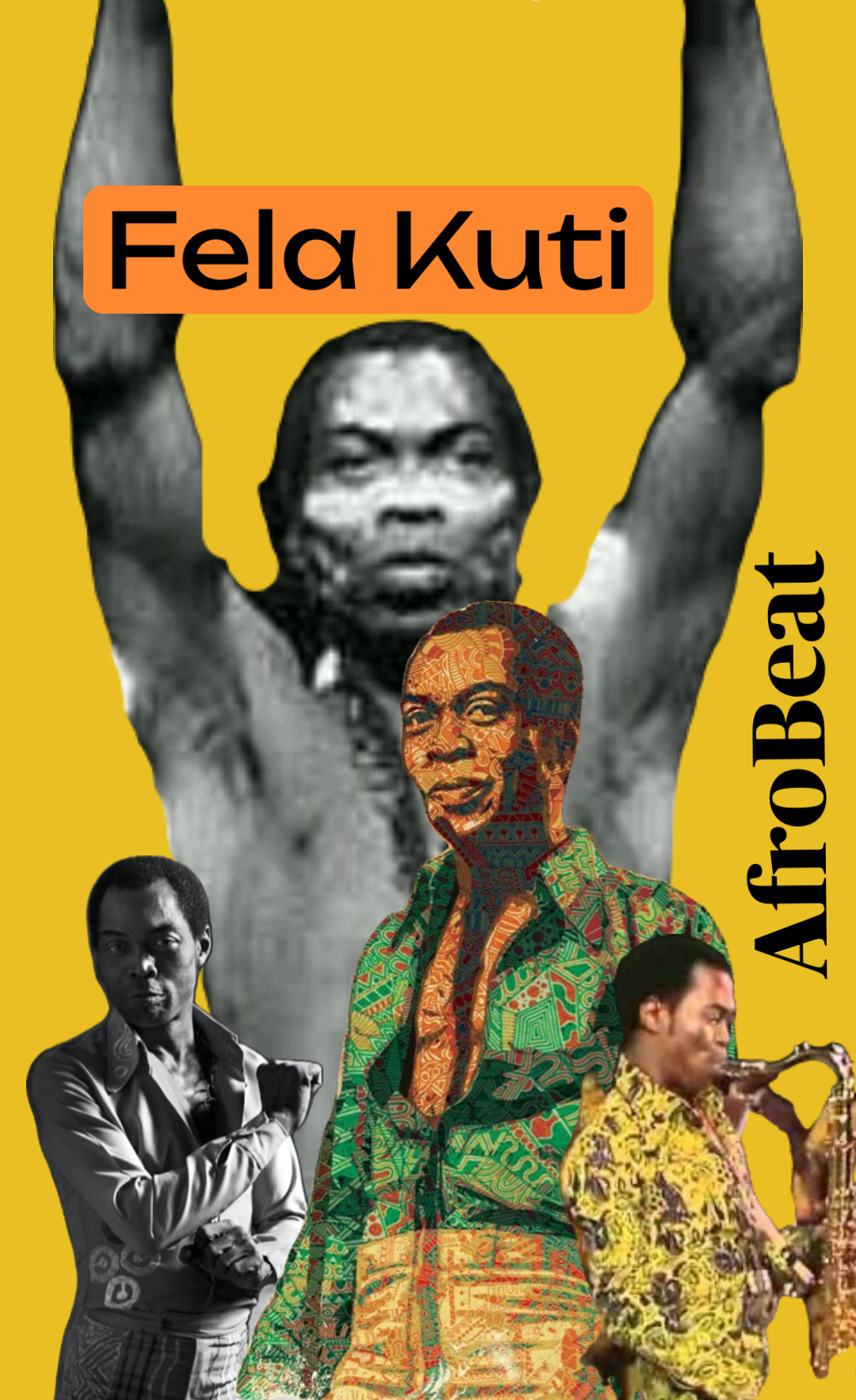
Olufela Olusegun Oludotun Ransome-Kuti
Fela Aníkúlápó Kútì (born Olufela Olusegun Oludotun Ransome-Kuti; 15 October 1938 – 2 August 1997) was a Nigerian musician and political activist. He is regarded as the principal innovator of Afrobeat, a Nigerian music genre that combines West African music with American funk and jazz.[1] At the height of his popularity, he was referred to as one of Africa's most "challenging and charismatic music performers".[2] AllMusic described him as "a musical and sociopolitical voice" of international significance.[3]
Kuti was the son of Nigerian women's rights activist Funmilayo Ransome-Kuti. After early experiences abroad, he and his band Africa '70 (featuring drummer and musical director Tony Allen) shot to stardom in Nigeria during the 1970s, during which he was an outspoken critic and target of Nigeria's military juntas.[3] In 1970, he founded the Kalakuta Republic commune, which declared itself independent from military rule. The commune was destroyed in a 1978 raid that injured Kuti and his mother.[4] He was jailed by the government of Muhammadu Buhari in 1984, but released after 20 months. He continued to record and perform through the 1980s and 1990s. Since his death in 1997, reissues and compilations of his music have been overseen by his son, Femi Kuti.[3]
Ella Jane Fitzgerald
Ella Jane Fitzgerald (April 25, 1917 – June 15, 1996) was an American singer, songwriter and composer, sometimes referred to as the "First Lady of Song", "Queen of Jazz", and "Lady Ella". She was noted for her purity of tone, impeccable diction, phrasing, timing, intonation, absolute pitch, and a "horn-like" improvisational ability, particularly in her scat singing.
After a tumultuous adolescence, Fitzgerald found stability in musical success with the Chick Webb Orchestra, performing across the country but most often associated with the Savoy Ballroom in Harlem. Her rendition of the nursery rhyme "A-Tisket, A-Tasket" helped boost both her and Webb to national fame. After taking over the band when Webb died, Fitzgerald left it behind in 1942 to start her solo career. Her manager was Moe Gale, co-founder of the Savoy,[1] until she turned the rest of her career over to Norman Granz, who founded Verve Records to produce new records by Fitzgerald. With Verve, she recorded some of her more widely noted works, particularly her interpretations of the Great American Songbook.
Fitzgerald also appeared in films and as a guest on popular television shows in the second half of the twentieth century. Outside her solo career, she created music with Louis Armstrong, Duke Ellington, and The Ink Spots. These partnerships produced songs such as "Dream a Little Dream of Me", "Cheek to Cheek", "Into Each Life Some Rain Must Fall", and "It Don't Mean a Thing (If It Ain't Got That Swing)". In 1993, after a career of nearly sixty years, she gave her last public performance. Three years later, she died at age 79 after years of declining health. Her accolades included 14 Grammy Awards, the National Medal of Arts, the NAACP's inaugural President's Award, and the Presidential Medal of Freedom.
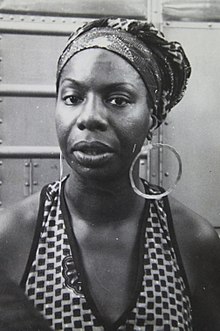
Nina Simone
Nina Simone (/ˈniːnə sɪˈmoʊn/ NEE-nə sim-OHN;[1] born Eunice Kathleen Waymon; February 21, 1933 – April 21, 2003) was an American singer, songwriter, pianist, composer, arranger, and civil rights activist. Her music spanned styles including classical, folk, gospel, blues, jazz, R&B, and pop. Her piano playing was strongly influenced by baroque and classical music, especially Johann Sebastian Bach,[2][3] and accompanied expressive, jazz-like singing in her contralto voice.[4][5]
The sixth of eight children born into a poor family in North Carolina, Simone initially aspired to be a concert pianist.[6] With the help of a few supporters in her hometown, she enrolled in the Juilliard School of Music in New York City.[7][8] She then applied for a scholarship to study at the Curtis Institute of Music in Philadelphia, where, despite a well received audition, she was denied admission,[9] which she attributed to racism.[10] In 2003, just days before her death, the institute awarded her an honorary degree.[11]
Early in her career, to make a living, Simone played piano at a nightclub in Atlantic City. She changed her name to "Nina Simone" to disguise herself from family members, having chosen to play "the devil's music" or so-called "cocktail piano".[9] She was told in the nightclub that she would have to sing to her own accompaniment, which effectively launched her career as a jazz vocalist.[12] She went on to record more than 40 albums between 1958 and 1974, making her debut with Little Girl Blue. She released her first and biggest hit single in the United States in 1959 with "I Loves You, Porgy" which peaked inside the top 20 of the Billboard Hot 100 chart.[6] Simone also became known for her work in the civil rights movement during the 1950s and 1960s,[13] and she later fled the United States and settled in France following the assassination of her friend Martin Luther King Jr. in 1968.[14] She lived and performed in Europe, Africa, and the Caribbean throughout the 1970s, 1980s, and 1990s.[15] In 1991, Simone published her autobiography, I Put a Spell on You (taking the title from her famous 1965 album), and she continued to perform and attract audiences until her death.[16]
Rolling Stone has ranked Simone as one of the greatest singers of all time on various lists.[17][18]
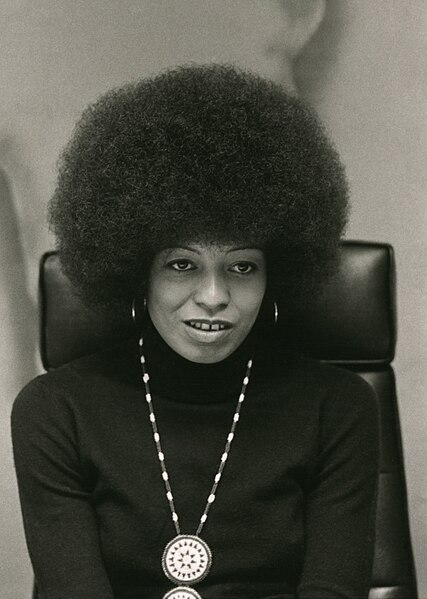
Angela Yvonne Davis
Angela Yvonne Davis (born January 26, 1944) is an American Marxist and feminist political activist, philosopher, academic, and author. She is Distinguished Professor Emerita of Feminist Studies and History of Consciousness at the University of California, Santa Cruz.[3] Davis was a longtime member of the Communist Party USA (CPUSA) and a founding member of the Committees of Correspondence for Democracy and Socialism (CCDS). She was active in movements such as the Occupy movement and the Boycott, Divestment and Sanctions campaign.
Davis was born in Birmingham, Alabama; she studied at Brandeis University and the University of Frankfurt, where she became increasingly engaged in far-left politics. She also studied at the University of California, San Diego, before moving to East Germany, where she completed some studies for a doctorate at the University of Berlin. After returning to the United States, she joined the CPUSA and became involved in the second-wave feminist movement and the campaign against the Vietnam War.
In 1969, she was hired as an assistant professor of philosophy at the University of California, Los Angeles (UCLA). UCLA's governing Board of Regents soon fired her due to her membership in the CPUSA. After a court ruled the firing illegal, the university fired her for the use of inflammatory language. In 1970, guns belonging to Davis were used in an armed takeover of a courtroom in Marin County, California, in which four people were killed. Prosecuted for three capital felonies—including conspiracy to murder—she was held in jail for over a year before being acquitted of all charges in 1972.
During the 1980s, Davis was twice the Communist Party's candidate for vice president. In 1997, she co-founded Critical Resistance, an organization working to abolish the prison–industrial complex. In 1991, amid the dissolution of the Soviet Union, she broke away from the CPUSA to help establish the CCDS. That same year, she joined the feminist studies department at the University of California, Santa Cruz, where she became department director before retiring in 2008.
Davis has received various awards, including the Soviet Union's Lenin Peace Prize and induction into the National Women's Hall of Fame.[4] Due to accusations that she advocates political violence and due to her support of the Soviet Union,[5] she has been a controversial figure. In 2020, she was listed as the 1971 "Woman of the Year" in Time magazine's "100 Women of the Year" edition.[6] In 2020, she was included on Time's list of the 100 most influential people in the world.[7]